
 Kuiper Studio
What a website really costs, and why those prices
People ask us for a price before they ask us for a website. Fair enough, and the answer is a published grid: $509 excl. tax for a single page, $1,319 for six pages, $2,039 for ten. This explains what sits behind those numbers, which technology costs what, and why the price on the quote is almost never the cost of the project.
At Kuiper Studio a showcase website starts at $509 excl. tax for one page, $809 for three pages, $1,319 for six pages and $2,039 for ten pages. Past ten pages, the project gets quoted. These prices are published, they are the same for everyone, and you can read them without talking to us.
One point before the detail: we invoice in US dollars, and that is what the site shows. The grid itself is decided in euros, at €499, €799, €1,290 and €1,999 excl. tax respectively, then converted at a fixed commercial rate. The calculations in this article are about a European shop selling in euros, so they stay in euros, and the Stripe rates we quote are the ones published for France.
This article explains what sits behind those prices, what pushes a quote up, and above all what nobody puts in a quote.
The price does not come from a number of hours
Plenty of agencies sell a website by time spent. We sell it by the page, because the page is what you are buying. A page means a structure to decide, copy to write, images to prepare, an address to get indexed and one version per language. How long we take is our problem, not yours.
That way of counting has a direct effect on your quote: it is not beauty that sets the price, it is the number of decisions. A one-page site with a carefully built animation costs less than ten ordinary pages, because you only decide once what the subject is, in what order and for whom.
Four technical routes, four budgets
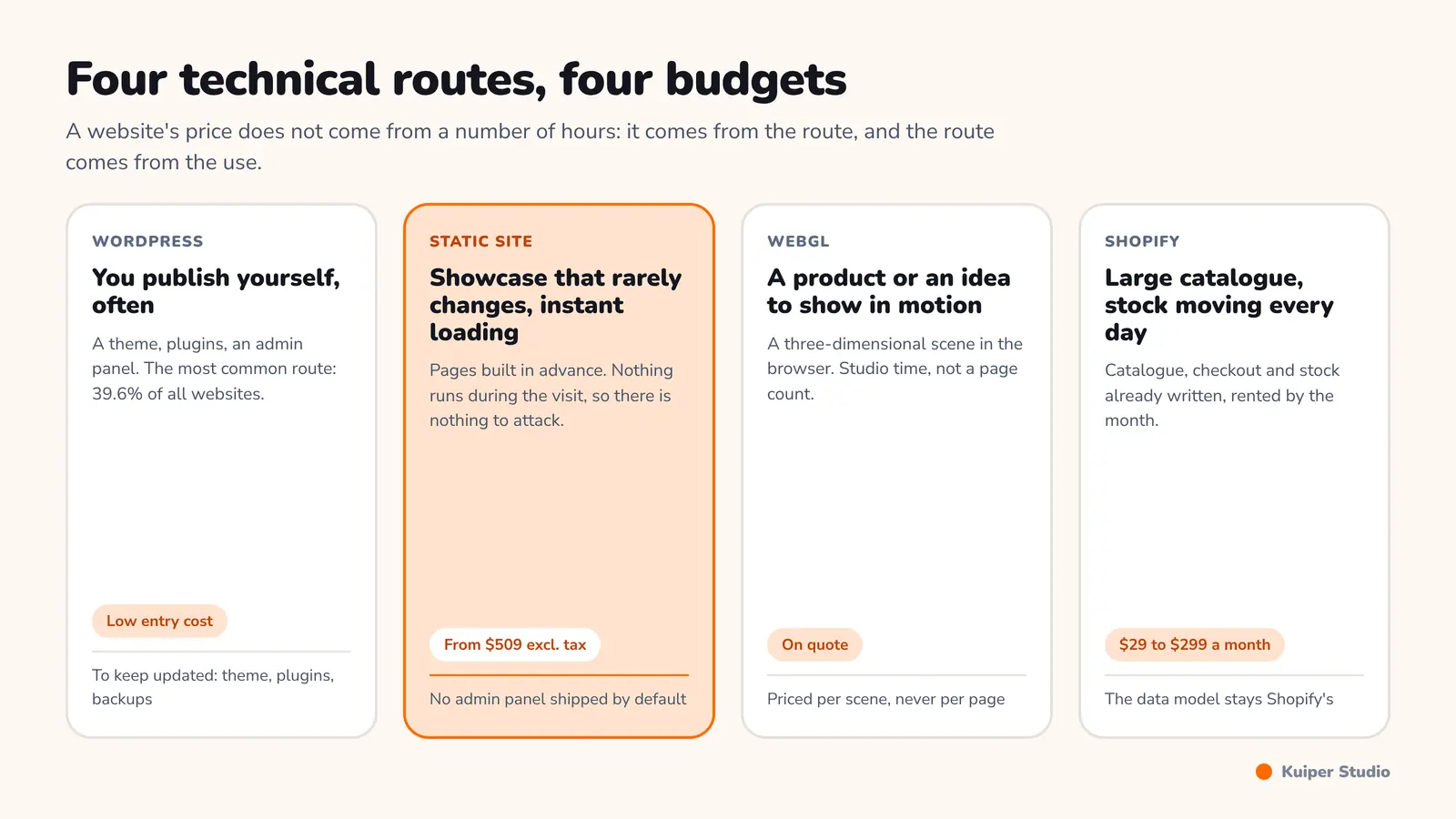
Before talking money, you need to know what you are building. There are four families of websites and they do not substitute for one another.
WordPress, when you publish yourself and often
WordPress runs 39.6% of all websites, which is 58.3% of those using a content management system, according to the W3Techs survey of 23 October 2026. That is not an accident: you get an admin panel, you write a post, you click publish. If your content changes every week and nobody on your side wants to touch code, this is the right route.
The entry price is the lowest on the market. The real cost shows up afterwards, and it recurs: a theme, plugins and a core to keep updated, backups to verify, and a surface to watch. Every plugin you install is code you did not write, running on your server on every visit.
The static site, when content rarely changes
This is our default route, and it is the one this site uses. Pages are built once at publish time, then served as they are. There is no database to query during the visit, so there is nothing to wait for and almost nothing to attack.
Let us be precise about what that implies, because this is the real trade-off: a static site does not arrive with an admin panel. Changing a price or publishing an article means editing a file, not filling in a form. We can attach an admin panel to it, and we do when the need is real, but that is a decision taken at quote stage, not a given. For a restaurant that changes its menu twice a year, an admin panel is useless. For a publication posting three times a week, it is essential.
WebGL, when showing beats explaining
Above that sit the websites that animate a three-dimensional scene in the browser. A product that turns, a material you look at closely, a mechanism you take apart. This is priced per scene and never per page: a single scene can take more work than ten pages of text.
We use it when a product is better understood in motion than in a photograph. A hand-stitched wallet, for example: the customer wants to see the grain of the leather and the stitching, not read a spec sheet. We model the object, often roughing it out with a generator such as Meshy, then rework it by hand, because a generator's raw output is not a product, it is a starting point.
Shopify, when the catalogue is large and the stock moves
Shopify accounts for 5.3% of all websites in the same survey. Its published October 2026 rates are $39 a month billed monthly, or $29 a month billed yearly, for the Basic plan. Grow is $105 or $79, Advanced is $399 or $299, and Plus starts at $2,300 a month. Card fees start at 2.9% plus 30 cents per online transaction on Basic.
If you sell four hundred references, your stock moves every day and you have a physical shop to keep in sync, rebuilding all of that bespoke would be absurd. Shopify has already written the cart, the checkout, the variants, the returns and the taxes. You rent them. That is a very good deal.
Two things are worth knowing before you sign.
First: you are entering an ecosystem you do not control. Shopify charges an extra fee if you use a payment provider other than its own, from 2% on Basic down to 0.2% on Plus. And the tools you depend on can disappear. Stocky, Shopify's own inventory app, included with point-of-sale subscriptions, has not been available since 31 August 2026, as Shopify's documentation states. Thousands of stores used it for their purchase orders. They had to move.
Second: Shopify manages quantities, not replenishment. A product's cost field holds a single figure, the purchase price. Freight, customs duties and prep fees do not go in it, and there is no native demand forecast or reorder point. Put plainly: Shopify knows how many units you hold, it does not know when to reorder or what a unit truly costs you landed in the warehouse. That is exactly the work you end up handing to one app, then another.
If your catalogue is large and your stock is alive, take Shopify. The mistake is not choosing it, the mistake is believing the subscription is the cost.
The quote is not the cost
Here is the calculation we run in front of a client before selling them anything. Take a shop selling €2,800 a month, with a €60 average basket, so around forty-seven orders a month. Over three years, meaning thirty-six months.
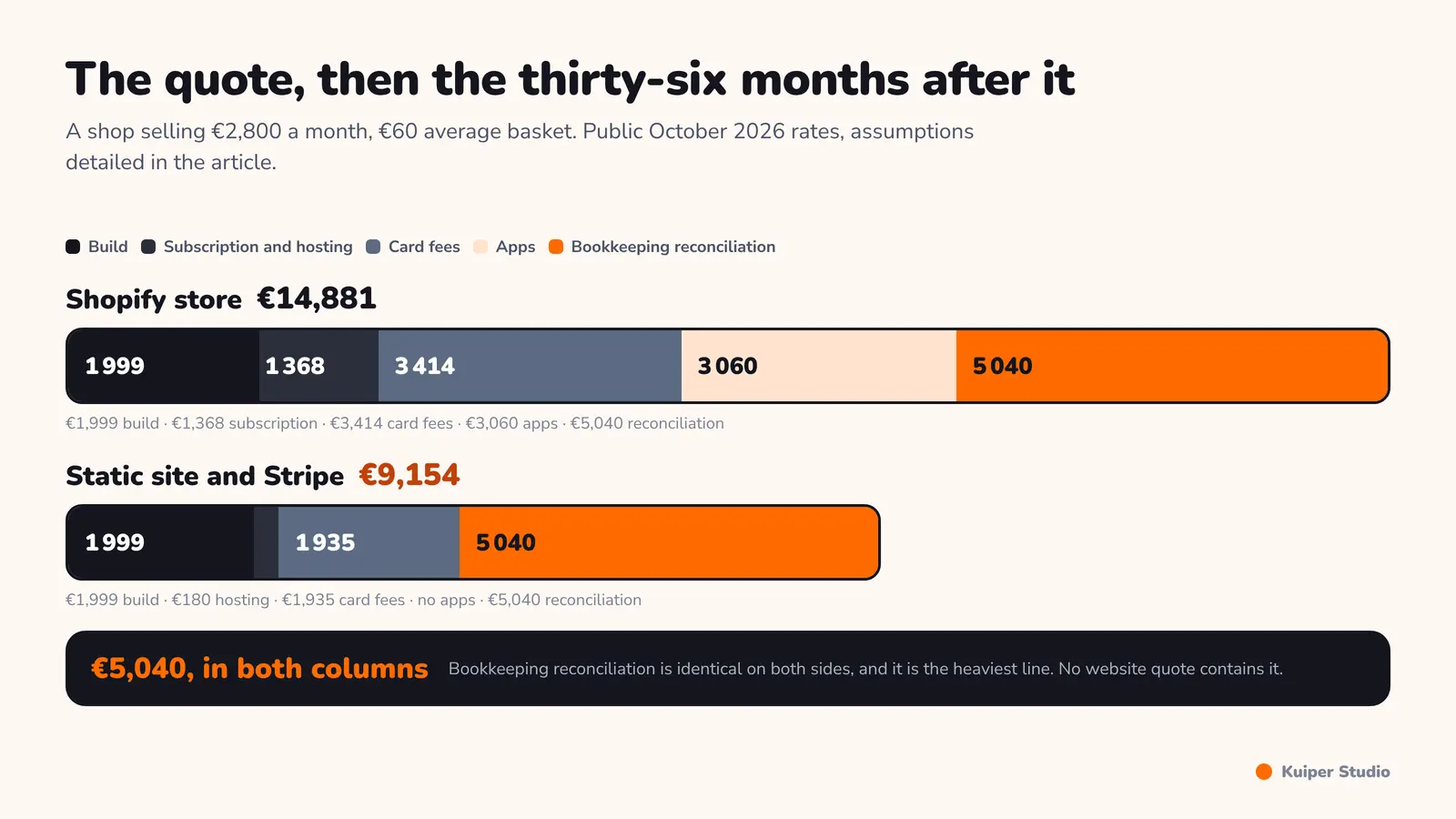
The assumptions, so you can redo the maths with your own. The subscription is converted at €1 for $1.02, the rate we use everywhere on this site, so roughly €38 a month. Card fees apply 2.9% plus €0.29 per order. Apps are estimated at €85 a month for three tools, which is low: a single stock synchronisation tool is billed between $10 and $300 a month depending on volume, at Stock Sync for instance. And bookkeeping reconciliation counts four hours a month at a €35 loaded hourly rate.
Against that, the same shop as a static site with Stripe. Stripe charges no monthly subscription: its published French pricing is 1.5% plus €0.25 for standard cards from the European Economic Area, 2.8% plus €0.25 for premium cards, and 3.15% plus €0.25 for international cards, with a further 2% on currency conversion. Hosting a static site costs a few euros a month.
The total goes from €14,881 to €9,154. But that is not the interesting figure.
The interesting figure is the largest line in both columns, and it is the same one: €5,040 of bookkeeping reconciliation. Matching payouts, which arrive net of fees and in batches, against the invoices you issued. Working out which sale a refund belongs to. Checking that the stock on display is the stock on the shelf. This work appears in no website quote, it is a third of the spend here, and it is owed whichever technology you pick.
That is why we sell automations from $399 excl. tax per flow. A flow that drops every payout into your accounts with its fee breakdown does not make your website prettier. It turns those four monthly hours into half an hour.
What pushes a quote up with us
Our options are published, like the packs. There is no "miscellaneous" line.
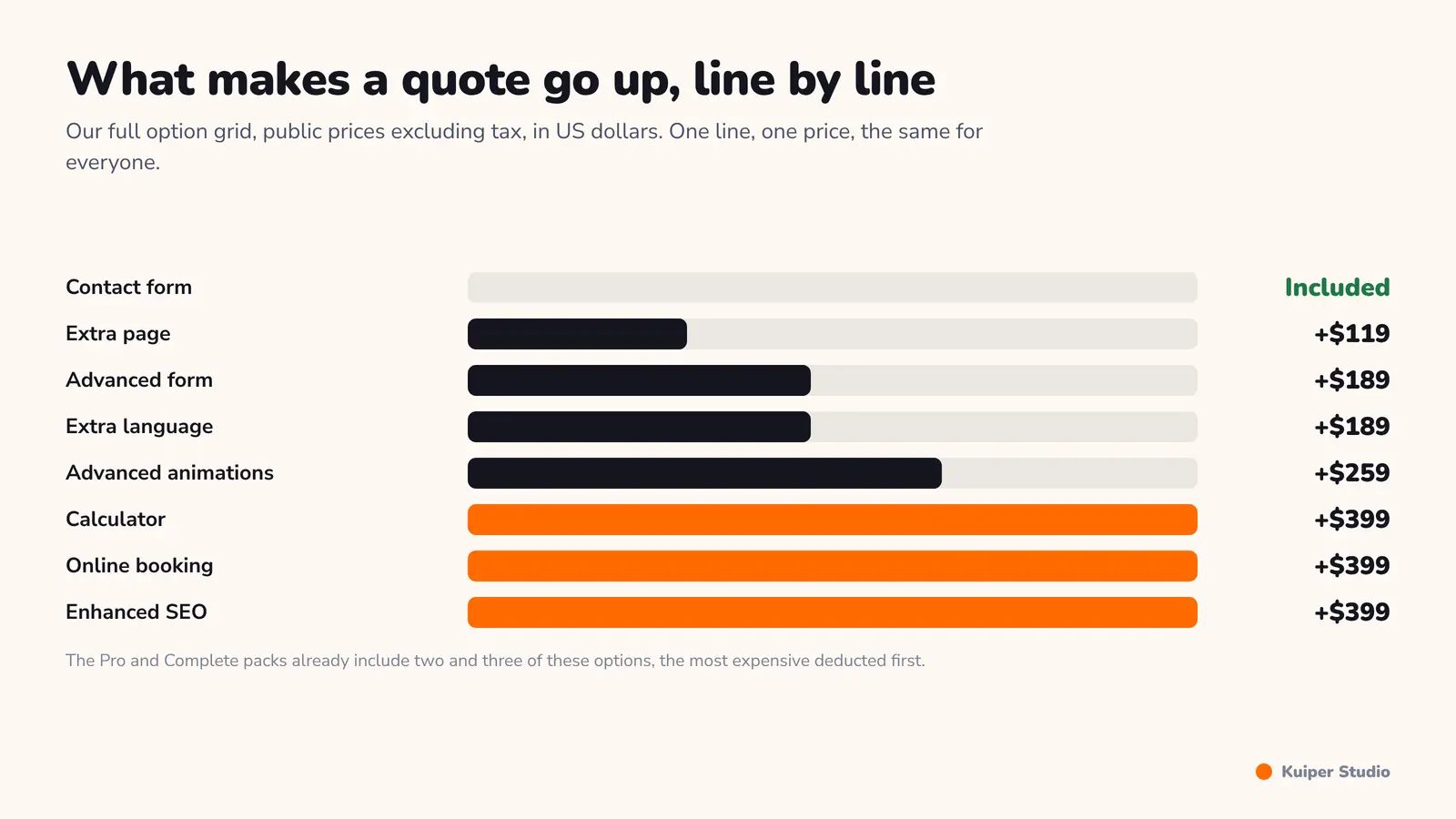
The contact form is included. An extra page costs $119 excl. tax. An advanced form or an extra language, $189. Advanced animations, $259. A calculator, online booking or enhanced SEO, $399 each. The Pro and Complete packs already include two and three of these options respectively, and the calculation deducts the most expensive first, because that is the reading most favourable to you.
Two things genuinely push a quote up, and neither is an option.
The first is content. If you arrive with your copy, your photographs and your prices, we build. If you arrive with an idea, the writing has to happen first, and writing takes time. It is the number one reason a project slips, and it has nothing to do with technology.
The second is connecting to the tools you already run. A website that lives alone is simple. A website that has to talk to your till software, your booking system and your accounts is an integration project, and an integration project gets quoted after looking at what your tools will actually agree to exchange. We never give that price over the phone.
What should never push a quote up
Three things ought to be included everywhere, and are sometimes sold separately. A site that displays properly on a phone. A site search engines can read. A site that loads fast. These are not options, they are the minimum conditions for anything else to matter. If a quote bills them as extras, ask to see what the version without them looked like.
Frequently asked questions
How much does a small business website cost?
At Kuiper Studio, from $509 excl. tax for a single page to $2,039 for a ten-page site, options excluded. The spread you will see elsewhere almost always comes down to three things: the number of pages, who writes the copy, and the technology chosen. A quote that does not state those three is not comparable to another.
Why do some websites cost $500 and others $15,000?
Because they are not the same object. A showcase site presents an activity and takes enquiries. A site that handles a catalogue, stock, payments and a connection to your till is software. The price follows the number of business rules to write, not the number of visible pages.
Is WordPress or a bespoke site better?
It comes down to one question: how often does your content change, and who changes it? If it is you, weekly, take WordPress and accept its upkeep. If your content moves twice a year, a static site will be faster, safer and cheaper to hold over time.
What does a Shopify store really cost over three years?
On a store selling €2,800 a month, our calculation gives roughly €14,881 over thirty-six months, of which only €1,999 is the build. The rest splits between the subscription, card fees, apps and above all bookkeeping reconciliation, which on its own is €5,040. That last line is the one to cost out before signing, not the subscription.
Sources
-
W3Techs, Usage statistics and market share of content management systems, survey of 23 October 2026.
-
Shopify, Pricing and plans, published rates consulted on 23 October 2026.
-
Shopify, Stocky, Help Center: "The Stocky app will no longer be available after August 31st, 2026", consulted on 23 October 2026.
-
Stripe, France pricing, published rates consulted on 23 October 2026.
What are we building together?
Tell us where it hurts. We answer with a price and a lead time.