 Kuiper Studio
Why restaurants fail: it starts with the location
There is no miracle fix for a restaurant that is not working. A restaurant is a science: a measured location, an identified clientele, an offer built for them and costs held under control. This first article covers the one decision you can never undo once the lease is signed.
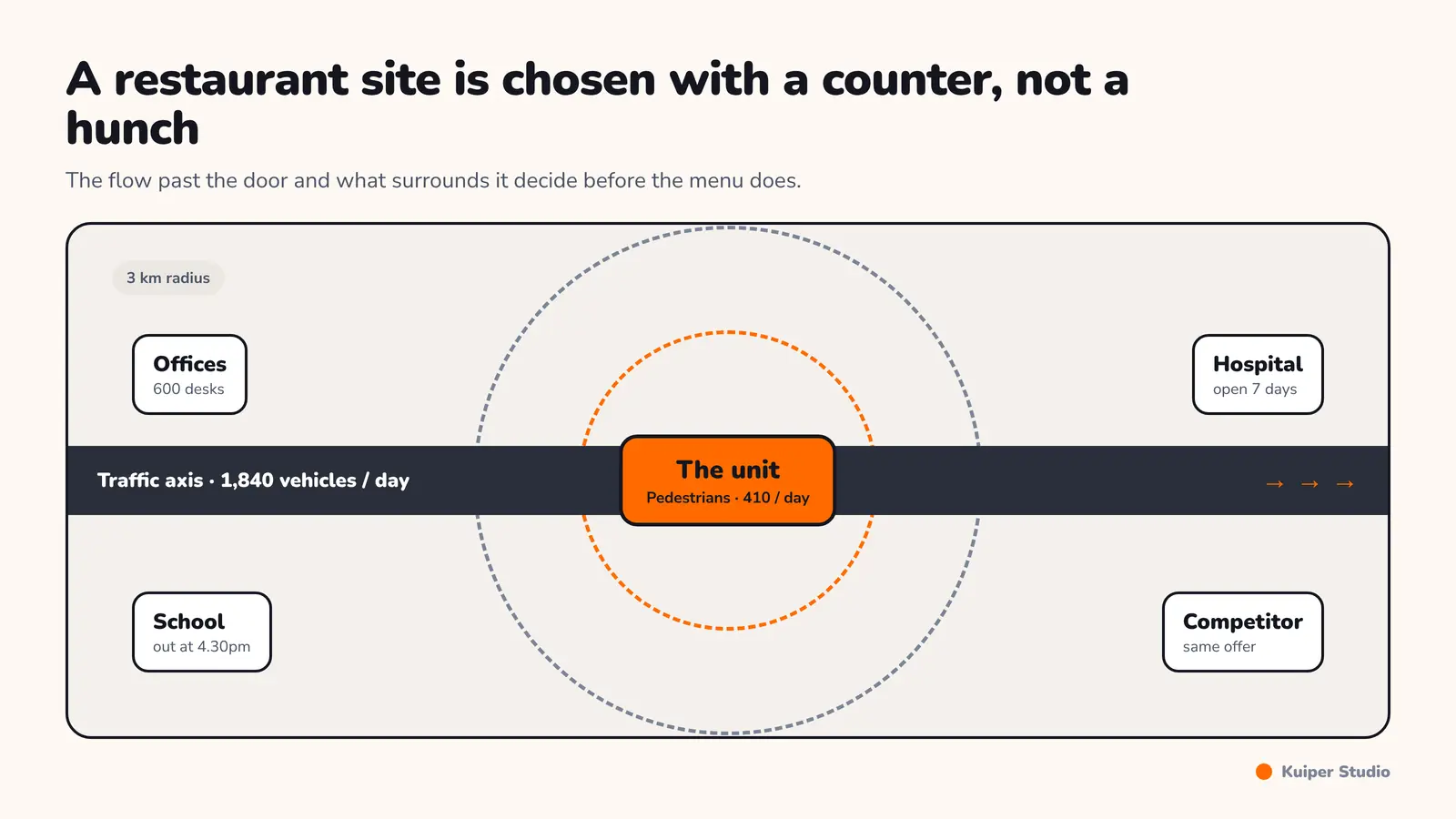
In consulting the question nearly always arrives in the same shape: it is not working, do you have a solution? And I nearly always give the same answer: no, there is no miracle solution. There is a sequence of decisions, taken in the right order, and the first ones weigh far more than the last ones.
The myth that 90% fail in the first year
Everyone repeats that nine restaurants in ten close within a year. That number never came from a study; it spread largely through an advertisement aired in 2003. Academic work gives a very different, and far less fatalistic, answer.
26.16%
of independent restaurants close in their first year, according to the reference study published in the Cornell Hotel and Restaurant Administration Quarterly
<small>Source: H. G. Parsa, John T. Self, David Njite, Tiffany King, August 2005</small>
Why Restaurants Fail, published in August 2005 by H. G. Parsa, John T. Self, David Njite and Tiffany King, followed operating permits issued by the health department of Columbus, Ohio, over three years. One point of method matters: the authors count changes of ownership as failures, not only bankruptcies. The rate of outright closures is therefore lower still.
What that number changes for you
Three independent restaurants in four survive their first year. Failure is neither a fate of the trade nor a matter of luck. It is prepared, and it is avoidable, through decisions that are mostly taken before opening day.
“It is good, so people come” is false
This is the most stubborn myth in the business. We imagine an excellent restaurant pulls people in automatically, and that an empty room means bad food. Both are wrong. Quality is what makes a guest come back. It is not what makes them walk in the first time.
What makes them walk in the first time is that they pass by, that they see you, that they can stop, and that what they read on your front matches what they wanted at that exact point in their day. Four conditions, none of which is about cooking.
First decision: measure the traffic, do not estimate it
Favour main roads and high traffic locations. But do not trust your impression: a street always looks busy when you visit it on a Saturday at noon with the urge to open something there. You have to count.
The method I give everyone who wants to open fits in one sentence: stand in front of the unit for one hour a day and count the vehicles and pedestrians going past. Do it for a full week, at the same hours. You get an average, and more importantly you get the shape of the week: the dips, the peaks, the Sunday.
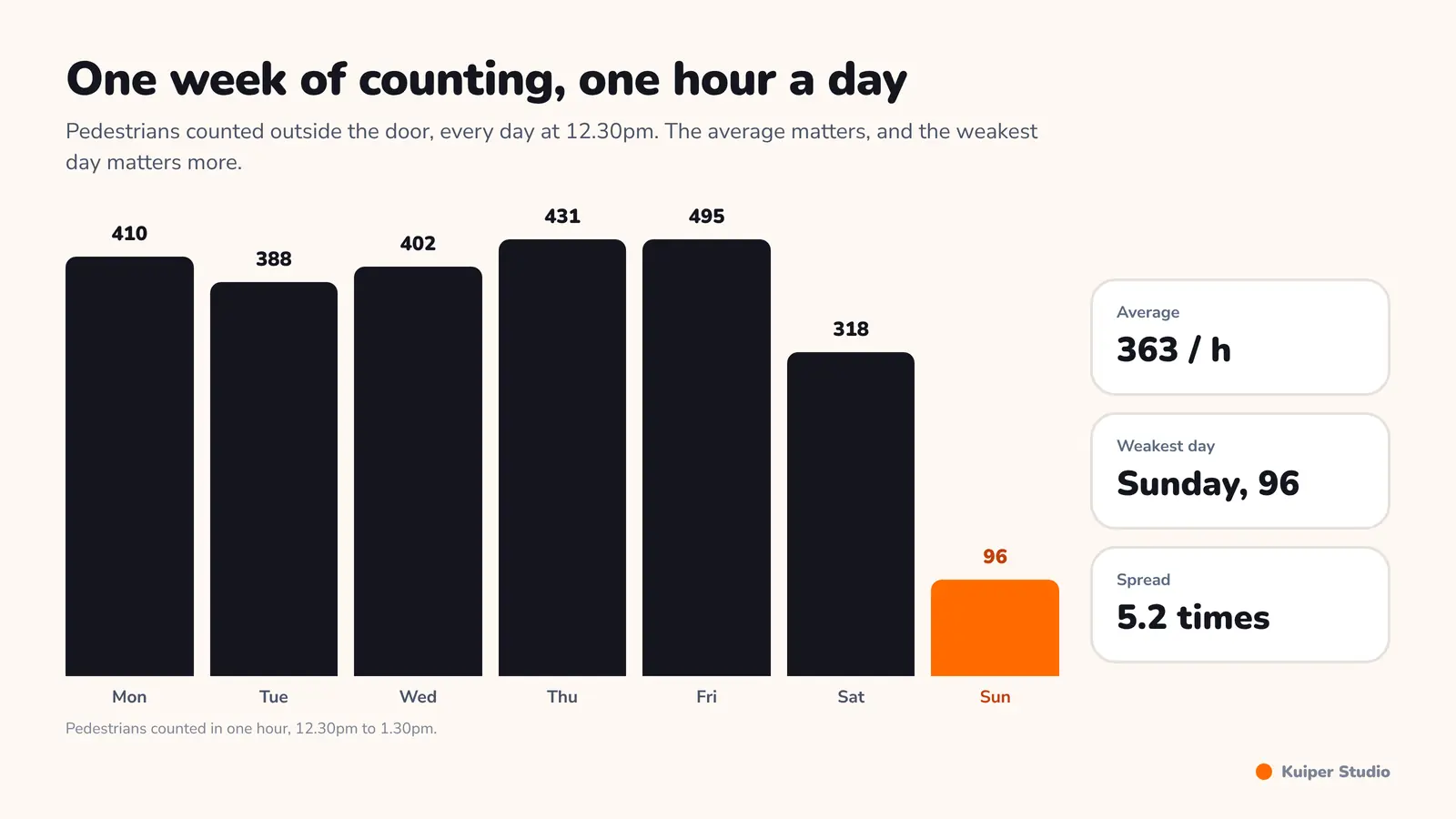
One week of counting, one hour a day, at the same hours. It is slow, and it is the cheapest data you will ever buy.
That flow is not your revenue, obviously. It is the pool you will draw from. A share of those passers by can stop; all your later work consists of raising that share. But if the pool is empty, no recipe will fill it.
- Count at fixed hours, one hour a day, seven days running.
- Separate vehicles from pedestrians: they are not the same customers.
- Note the direction of travel: a flow heading home from work does not stop like a flow leaving for the weekend.
- Check that stopping is possible: parking two hundred metres away cancels part of the traffic.
- Judge real visibility from the road, at the speed of the road, not on foot.
Second decision: read the catchment area
Traffic alone is not enough. Within a three to four kilometre radius, look at what generates people, and at what time. Large employers, hospitals, banks, government offices, schools, hotels. Each produces a different flow, at a different hour, with a different budget.
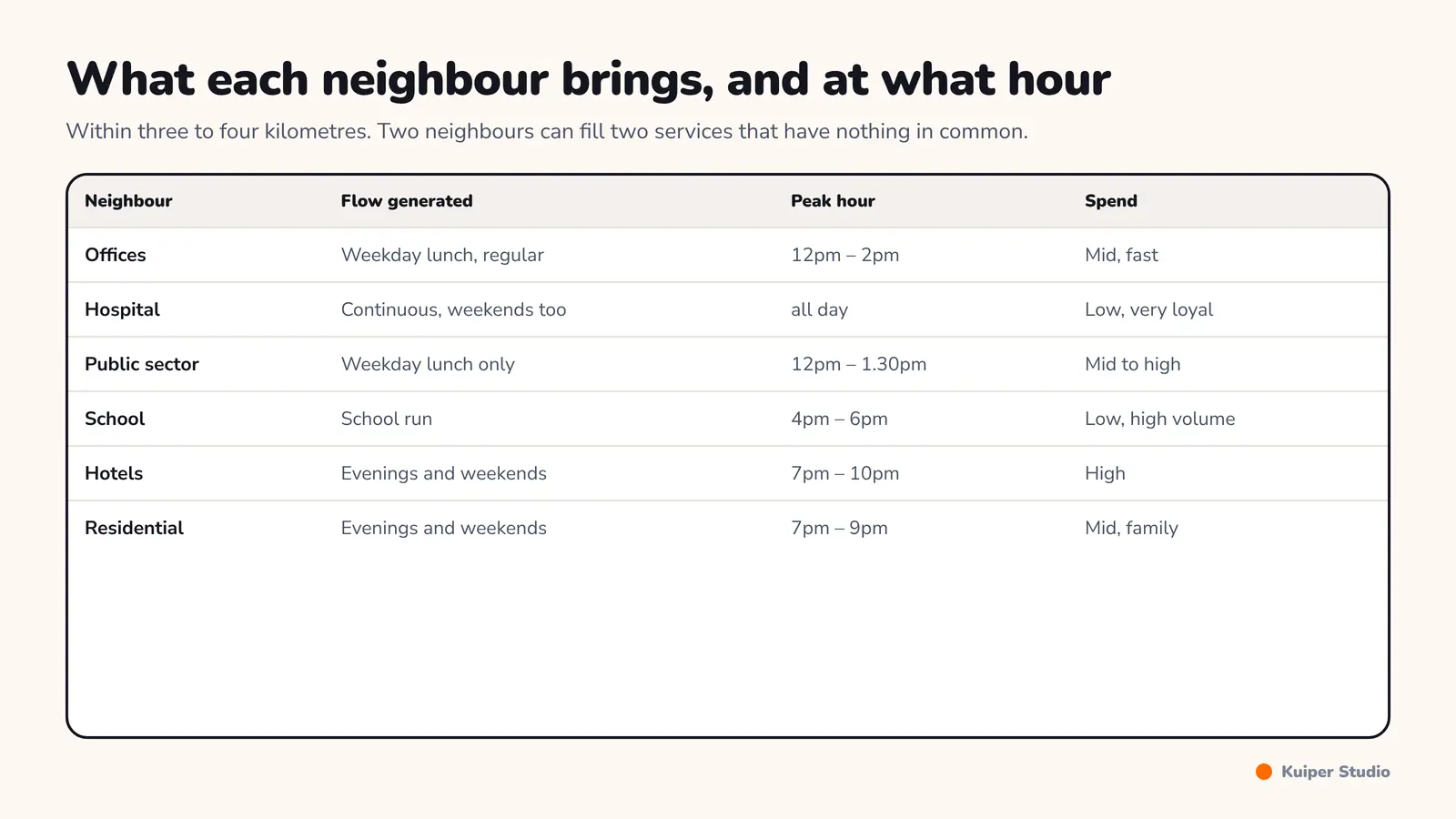
The same address is not worth the same depending on what surrounds it. A hospital fills a weekday lunch, not a Saturday night.
What each neighbour brings, and when
| Neighbour within 3 to 4 km | Flow generated | Peak hour | Typical spend |
|---|---|---|---|
| Offices and large employers | Weekday lunch, regular | 12pm to 2pm | Mid, fast, repetitive |
| Hospital or clinic | Continuous, weekends included | All day | Low, but very loyal |
| Government offices and banks | Weekday lunch only | 12pm to 1.30pm | Mid to high |
| School | School run, accompanying adults | 4pm to 6pm | Low ticket, high volume |
| Hotels | Evenings and weekends | 7pm to 10pm | High, price insensitive |
| Residential area | Evenings and weekends | 7pm to 9pm | Mid, family sized |
Ask three questions of every address: why here, who passes, and at what hour. A very good location is no guarantee of success; it is one factor among several, and success is cumulative. You can fail at an excellent address, and succeed on a dead end street.
A dead end street can beat a main road
It sounds counter intuitive, and it happens constantly. A corner unit on a street with no through traffic can out earn a frontage on a main road. Why? Because geographic position is not only the road. It is also the zone: what surrounds it, who works there, who sleeps there, and what is missing on site.
A busy main road where nobody can stop, where cars run at sixty, and where the nearest competitor has been doing exactly your concept for fifteen years, is a bad location. A quiet street backing onto six hundred desks with no lunch offer at all is an excellent one. Traffic is one input. The zone is another. You need both.
The grid to fill in before signing
Before a lease is signed, I always ask for these lines to be filled with numbers rather than impressions. If one line stays empty, the decision is not ready.
- Average daily passers by, vehicles and pedestrians counted separately, measured over seven days.
- The split of that traffic by time slot, and the weakest day of the week.
- A list of footfall generators within 3 to 4 km, with estimated headcount and peak hour.
- Competing offers already serving each time slot, and their average price.
- Stopping conditions: parking, pavement, direction of travel, visibility at road speed.
- Rent and charges converted into the number of covers you must serve every day to cover them.
The last line is the one that stops the most founders, and that is a good thing. It turns a monthly rent into a number of covers per day. From there you can tell whether the traffic measured in point one can plausibly supply that number.
The next article in this series moves to the following step: defining the offer and the message around the clientele you are going after, then building the menu from that message rather than the other way round.
Frequently asked questions
How long should I count foot traffic in front of a restaurant site?
One hour a day, at the same hours, for seven consecutive days. That gives you an average and, more usefully, the shape of the week including its weakest day. A single day of counting is worthless: a rainy Tuesday and a sunny Saturday have nothing in common.
What radius should I use for a restaurant catchment area?
Three to four kilometres for an urban lunch trade, because that is the distance a working adult will cover on a lunch break. The radius widens in the evening and at weekends, when the trip is chosen rather than imposed, and shrinks sharply in a dense city centre where everything happens on foot.
Can a restaurant succeed on a street with no passing trade?
Yes, provided the zone compensates for the traffic. A quiet street backing onto several hundred desks with no competing lunch offer beats a main road where nobody can stop. Traffic and zone are two separate criteria, and both need measuring before you sign.
Is it true that 90% of restaurants close in their first year?
No. Why Restaurants Fail, published in 2005 in the Cornell Hotel and Restaurant Administration Quarterly, measured a 26.16% first year failure rate among independents, and counted changes of ownership as failures. The 90% figure comes from no study at all.
Sources
-
H. G. Parsa, John T. Self, David Njite, Tiffany King, Why Restaurants Fail, Cornell Hotel and Restaurant Administration Quarterly, vol. 46, no. 3, pp. 304-322, August 2005.
-
Hospitality Net, Why New Restaurants Fail, a summary of the Parsa study findings, 2005.
What are we building together?
Tell us where it hurts. We answer with a price and a lead time.