 Kuiper Studio
Hotel guest data: why remembering a guest beats redecorating a room
A hotel that remembers its guests sells more than a hotel that is merely beautiful. Medallia found that only 23% of guests experienced a highly personalised recent stay, while personalisation is the first reason people agree to spend more. Here is what that means in practice, and where to start.
I spend most of my working life with hoteliers and restaurateurs. The same scene plays out almost every time: I am shown the new lobby, the new spa, the new façade. I am almost never shown what the property knows about its guests. That is where the difference is made today.
The real problem: more hotels, fewer decisions made on data
There are more hotels every year, and fewer decisions driven by guest data. Most properties try to stand out through design. Very few try to stand out through service aimed at one named person. Design is copied within six months. What you remember about your guests is not.
Large hotel groups spend heavily on knowing their guests. That is not a marketing indulgence: it is the only asset a competitor cannot duplicate. Anyone can rebuild your rooms. Nobody else knows that the guest in 412 hates feather pillows and orders tea at 7am.
23%
of hotel guests reported a highly personalised recent stay, out of 1,749 guests surveyed
<small>Source: Medallia, 15 February 2024</small>
That figure comes from Medallia research published on 15 February 2024, covering 1,749 hotel guests and 1,905 retail consumers. The same release restates that 61% of consumers are willing to spend more for a customised experience. Demand is there; supply barely follows.
Two stays, two memories
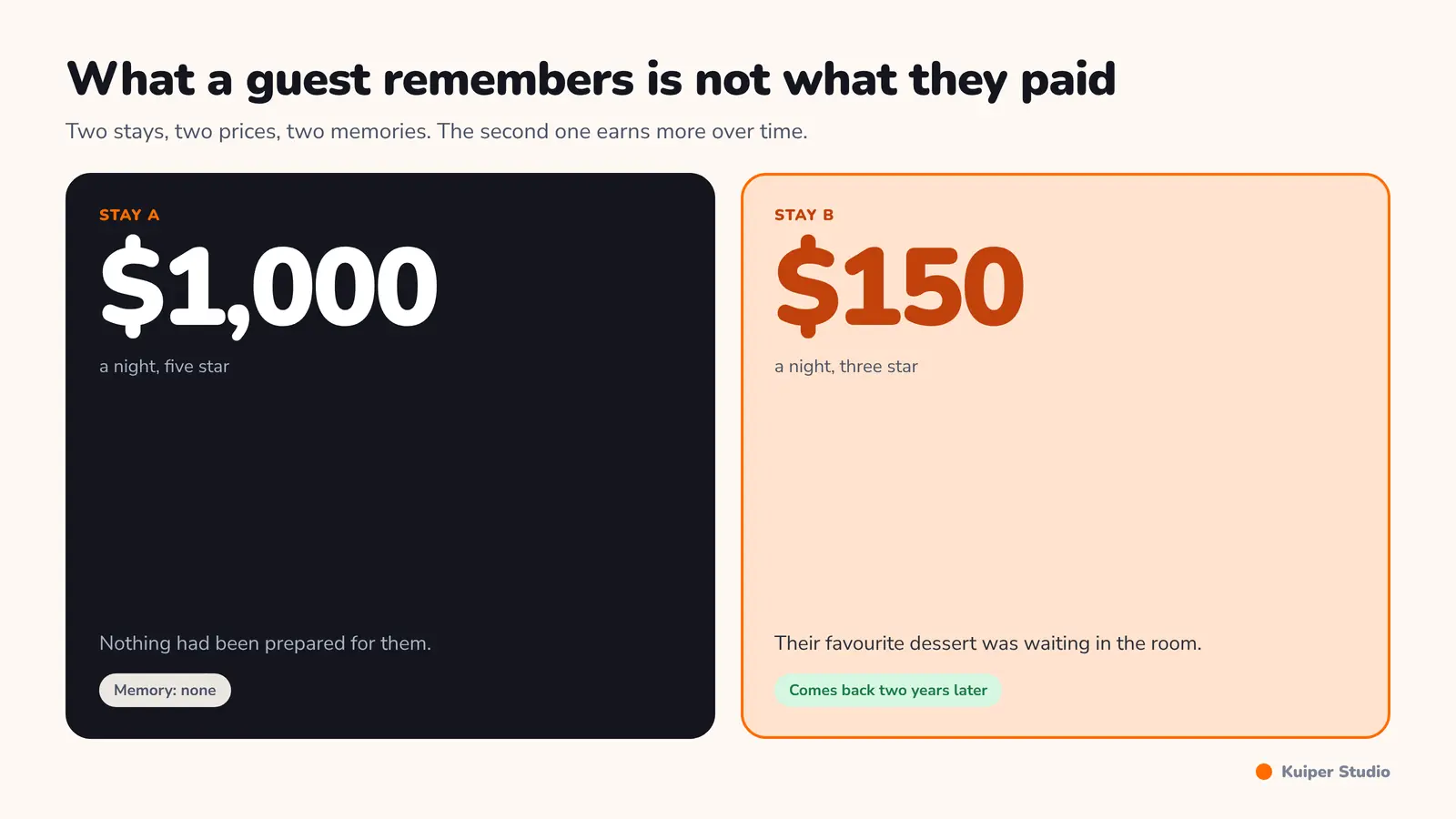
Take a simple example. You check into a five star hotel. You paid 1,000 dollars for the night. The room is beautiful. And that is all it is. You go down for dinner, the service is correct, you go back up. A good stay. A forgettably good stay. In six months you will not remember the name.
Now take a 150 dollar room in a three or four star property. On arrival you find one of your favourite desserts waiting, or a small gesture that is clearly about you. Two years later you come back. You had loved a salmon pasta dish you told friends about. It is on the menu the evening you arrive.
Luxury today is attention, not square metres
The best hotel is not the one with the most beautiful room, even though the room still matters enormously. It is the one that knows its guest. A three dollar gesture placed at the right moment for the right person is remembered longer than an anonymous thousand dollar suite.
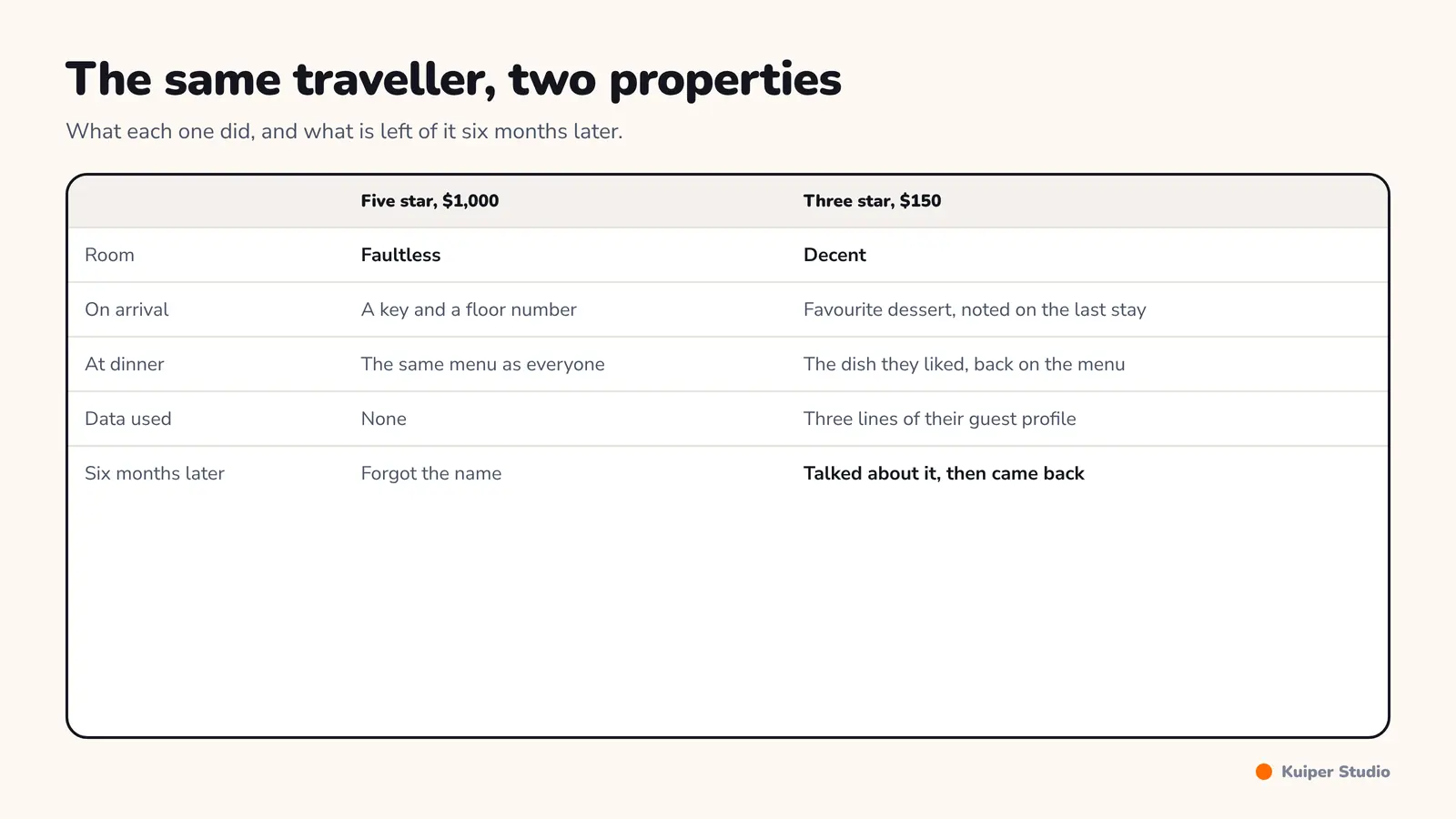
The room rate does not decide the memory. What was prepared for that guest does.
No one remembers a thousand guests, software does
No general manager can remember what every guest eats, drinks, avoids or asks for each morning. That is humanly impossible, and it is not the point. The point is to have a system that remembers for them, and surfaces it at the right moment, three days before arrival.
In practice this is one profile and one alert. The profile gathers what the property has already observed. The alert reaches the team before the guest does. None of this requires frontier artificial intelligence. It requires the data to stop being locked inside four systems that do not talk to each other.
- What they ordered, and what they never ordered a second time.
- Allergies, diets and refusals: noise, floor, pillow type.
- Their rhythm: arrival time, breakfast time, average length of stay.
- Their context: business or family, alone or with someone, and with whom.
- What they said: one remark at the desk is often worth more than a survey.
- What they spent outside the room, line by line.
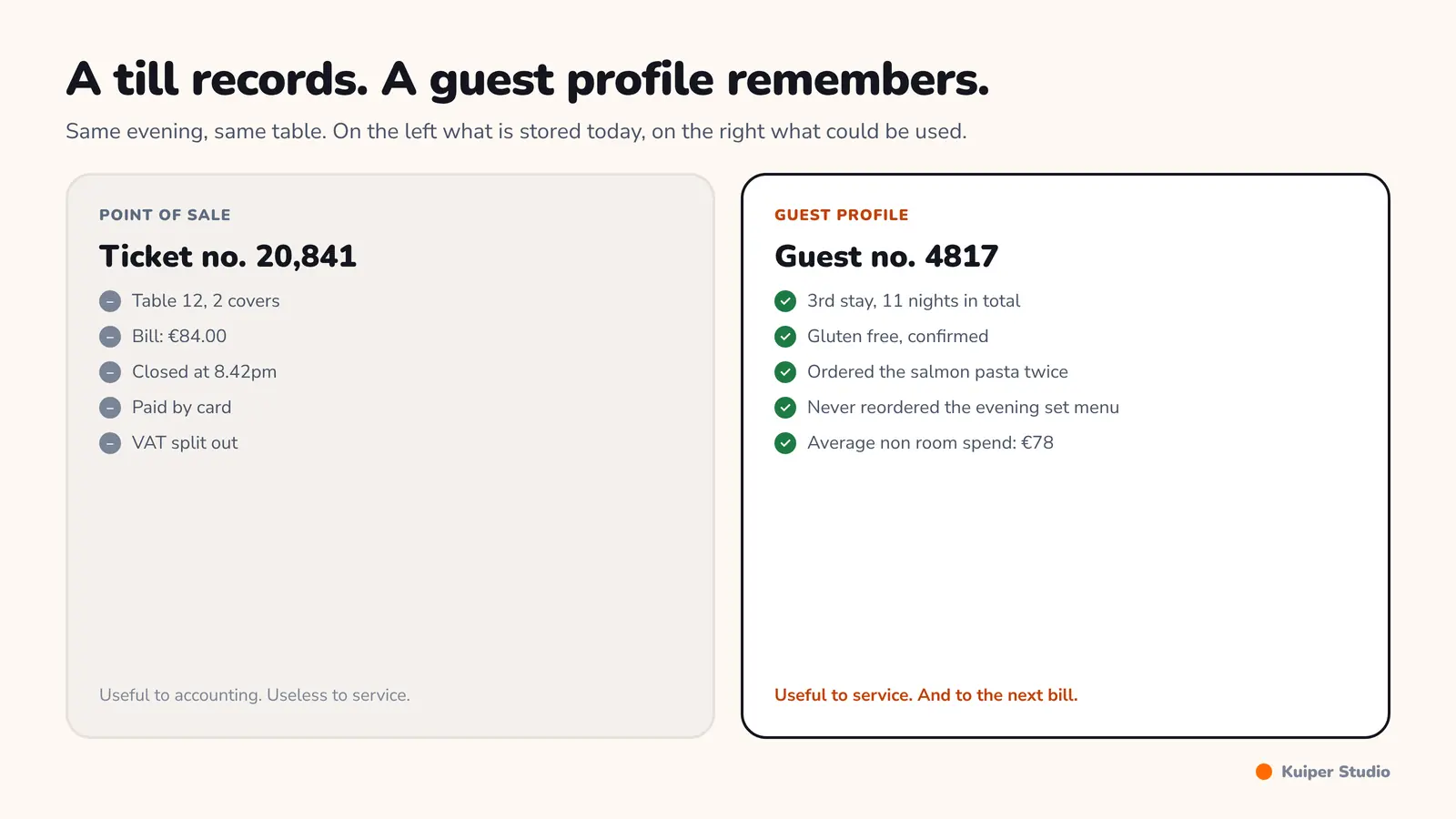
A point of sale records a transaction. A guest profile retains a person. Different data, and very different value.
The market already decided: the point of sale is not the product
If this sounds theoretical, follow the money. SevenRooms is a table management and guest relationship platform for restaurants and hotels. Its history is the clearest summary of where the value moved.
In October 2018 the Amazon Alexa Fund invested in SevenRooms. It was the fund's first restaurant technology investment, built around letting floor staff query the guest database by voice during service: who is seated at table 12, who in the room has an allergy.
On 6 May 2025 DoorDash announced it would acquire SevenRooms for about 1.2 billion dollars. The deal closed on 13 June 2025, and DoorDash's quarterly filing with the SEC values the consideration at 1,152 million dollars. Order taking is not what commands that price. A guest knowledge base is.
$1.2bn
paid by DoorDash in 2025 for SevenRooms, a guest data platform rather than a till
<small>Source: DoorDash, Inc. (SEC), 30 June 2025</small>
A till has no value of its own
A point of sale takes an order, takes the money, and stops there. The value is not in the transaction, it is in what the transaction reveals: eating habits, frequency, basket size, a refusal. Many properties pay for a till every month and throw that information away every night.
What it looks like for the team
The goal is not one more dashboard. The goal is that a front desk agent with four minutes between two arrivals can see, in one line, what to do. A profile that takes ten minutes to read will never be read.
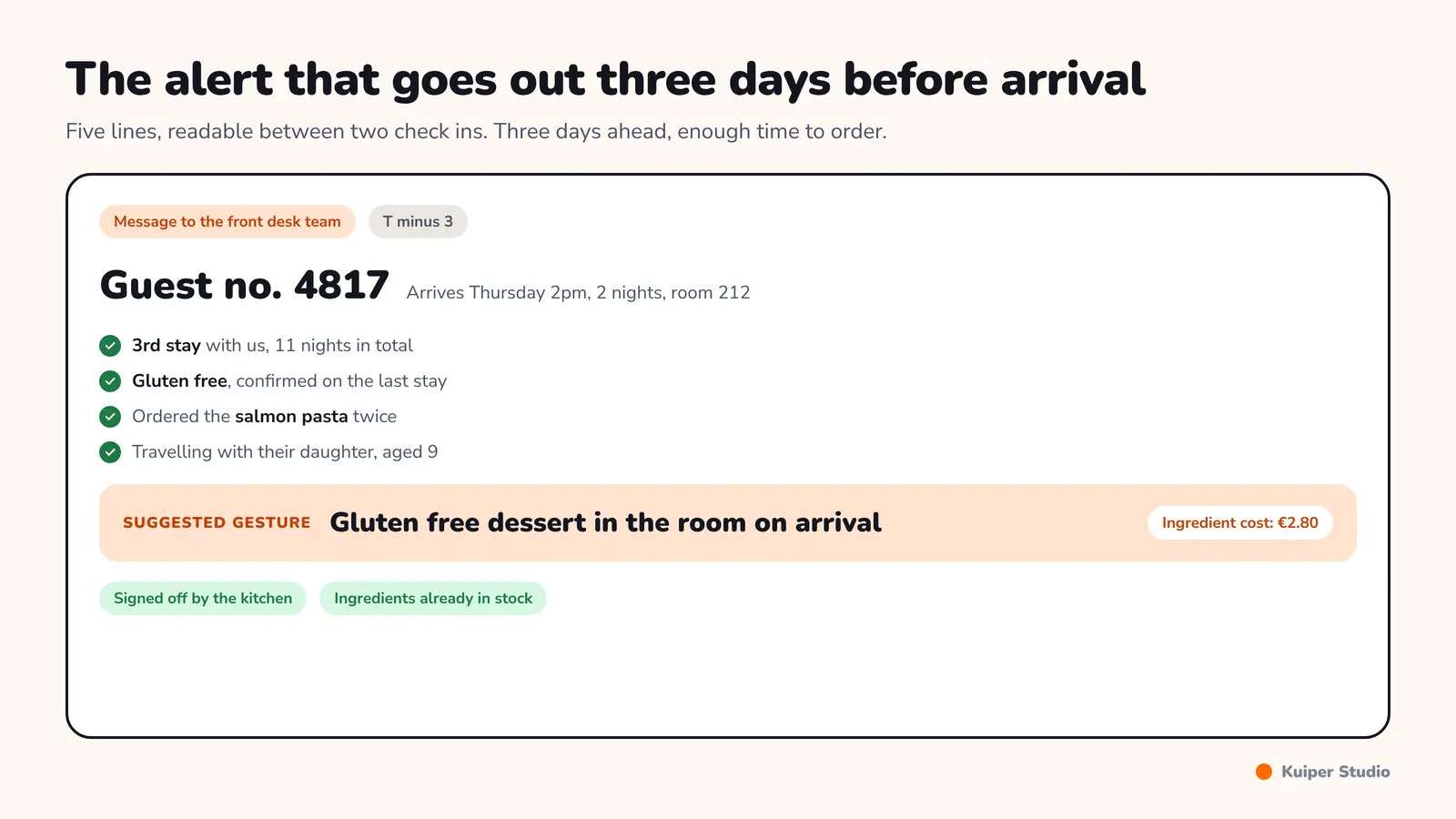
A useful alert fits in five lines and lands three days ahead, not on the day: someone has to order the dessert.
- Three days before arrival, the team receives a profile for each expected guest.
- The profile recalls previous stays, habits and what landed well last time.
- It suggests a gesture the kitchen can deliver from stock it already holds.
- After checkout, what was offered and how the guest reacted goes back into the profile.
Where to start without replacing anything
I rarely advise replacing the system already in place. Swapping a PMS or a point of sale mid season is a bad idea, and it is almost never required to get the result described above.
- List the software already running and what each one actually stores: bookings, till, spa, email.
- Pick one guest profile as the reference, and decide which system is its source of truth.
- Connect the other systems to that profile one way first: read only, no writing back yet.
- Trigger a pre arrival alert for a single guest segment, for one month.
- Measure non room spend for that segment before and after, then extend if the number moves.
This is the kind of chain we build at Kuiper Studio: connect software that already exists, establish a single guest profile, and surface the information where staff actually work rather than in a monthly report nobody opens.
Frequently asked questions
Do we need to replace our PMS or point of sale to personalise a stay?
In most cases, no. Nearly every PMS and till on the market exposes an API or an export. Connecting what you already run to a single guest profile is faster and far less risky than replacing a live system. Replacement is only justified when the current software allows no export at all, which is rare.
How much data is needed before this is useful?
Far less than people assume. A second stay is already enough to produce an accurate gesture: what someone consumed the first time is the single most useful field you will ever hold. There is no need to wait for thousands of profiles before using the ones you have.
Is it legal to keep a record of a guest's consumption habits?
Yes, provided you respect the framework that applies to your guests, including the GDPR for European Union residents: inform the person, state the purpose, limit how long you keep the record, and allow access and deletion. Health related preferences such as an allergy need particular care and explicit consent.
How long does a first connected guest profile take to build?
For a single property whose software exposes an API, allow two to six weeks between the inventory of sources and the first alert reaching the team. Most of that time goes into deduplicating guest records, not into the engineering.
Sources
-
Medallia, Medallia Research Finds 61% of Consumers Are Willing to Spend More for Personalized Experiences, But Only 25% of Experiences Are Highly Personalized, 15 February 2024.
-
SevenRooms, SevenRooms Announces New Funding From Amazon Alexa Fund, 17 October 2018.
-
SevenRooms, DoorDash Acquires SevenRooms, 6 May 2025.
-
DoorDash, Inc. (SEC), Form 10-Q for the quarter ended 30 June 2025, note on the SevenRooms acquisition, 30 June 2025.
What are we building together?
Tell us where it hurts. We answer with a price and a lead time.